Behaviour Change Pathways to Improving Business Outcomes
Updated: Sep 23
Business outcomes. These tedious numbers are almost always undermined and inseparable from human behaviours (McCormack, 2014). Both the behaviours your leadership, middle management, and employees adopt, and the behaviours your customers and/or consumers undertake.
Changing any business outcome starts with changing human behaviours both within the organisation and the end user.
These behavioural insights are not soft observations. Failing to consider how individuals think, feel, behave, and ultimately perform (or consume) is the reason why so many technically sound strategies fall short of moving the envisioned numbers forward.
We've started treating AI as an exception.
Despite the importance of human-to-human interaction in any business transaction, I am constantly challenged by many senior-level executives with the notion that human behaviours are seemingly less relevant in an increasingly AI-automated business landscape.
The way we use AI is behaviour.
The mismatches between how we would ideally use AI and how AI is used in business processes are perhaps the biggest behavioral questions currently unanswered in the evolving business landscape, which many dangerously turn a blind eye to.
Facilitating behaviour change is about understanding behaviours that lead to desired outcomes.
Most organisations start behaviour change backwards with the intervention (a training, a new policy, a dashboard) before the diagnosis. The more useful sequence, borrowed from the behaviour-change literature in health psychology, starts with two questions:
What outcome/s are we aiming towards? (Higher AI adoption, better employee wellbeing, more consistent customer behaviour, higher productivity)
What specific behaviours, done consistently, lead to desired outcomes?
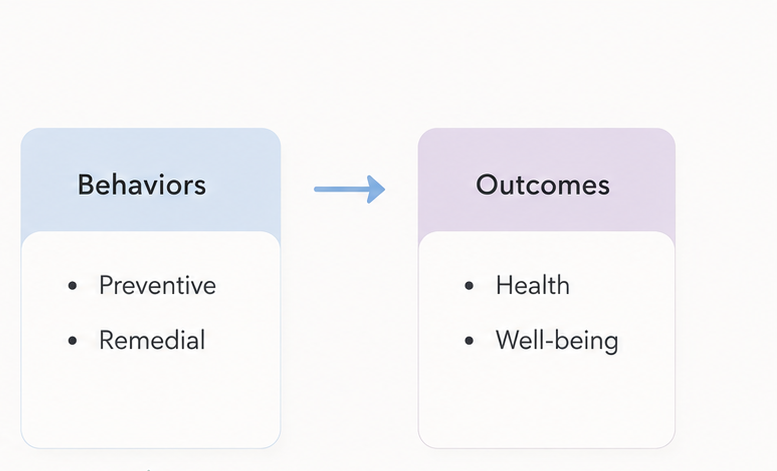
Behaviours are facilitated by a range of behavioural determinants.
These critical behaviours shaping business outcomes are either facilitated or hindered by a range of so-called behavioural determinants, such as having the capabilities, opportunities, and motivations to perform a given behaviour. Say your middle management would have all the capabilities (i.e., skills) and opportunities (i.e., time) to audit how AI is being implemented in your organisation; however, the desired behaviour will fall short if they do not have the motivations to do so, vice versa.

Capability- Does the person have the required skills and knowledge to do so?
Opportunity - Does their environment give them the time, access, and social support to do so?
Motivation - Does the person have the motivation and desire to do so?

Delivering high-impact interventions to target specific behavioural determinants
Most teams over-invest in capability-building (another training, another tool) when the actual gap may be opportunity or motivation. Diagnosing correctly before intervening is, in my experience, the single highest-leverage step most behaviour change efforts skip. To deliver interventions and solutions that lead to changes in business outcomes, we must first understand which behavioural determinants (as shown above) either facilitate or hinder the desired behaviours that lead to those outcomes.

If you're looking at a business outcome that isn't moving despite the right strategy on paper, that's usually a sign the behavioural diagnosis was skipped, or that you want to make sure that your strategy will move forward as planned,
Lasse Eini Co. provides the tools, frameworks and expertise necessary for understanding and shaping human behaviours, which lead to desired outcomes and business success stories.
Get in touch to learn how this may look for your team — Book here.
References
Atkins, L., Francis, J., Islam, R., O'Connor, D.., Patey, A., Ivers, N., Foy, R., Dunca, C.., Grimslaw, J. M., Lawton, R., & Michie, S. (2017). A guide to using the theoretical domains framework of behaviour change to investigate implementation problems. BMC Implementation Science, 6(42).
McCormack, M. H. (2014). What they don't teach you at Harvard business school.
Michie, S., Stralen, M. M., & West, R. (2011). The behaviour change wheel: A new method for characterising and designing behaviour change interventions. Springer.


Comments